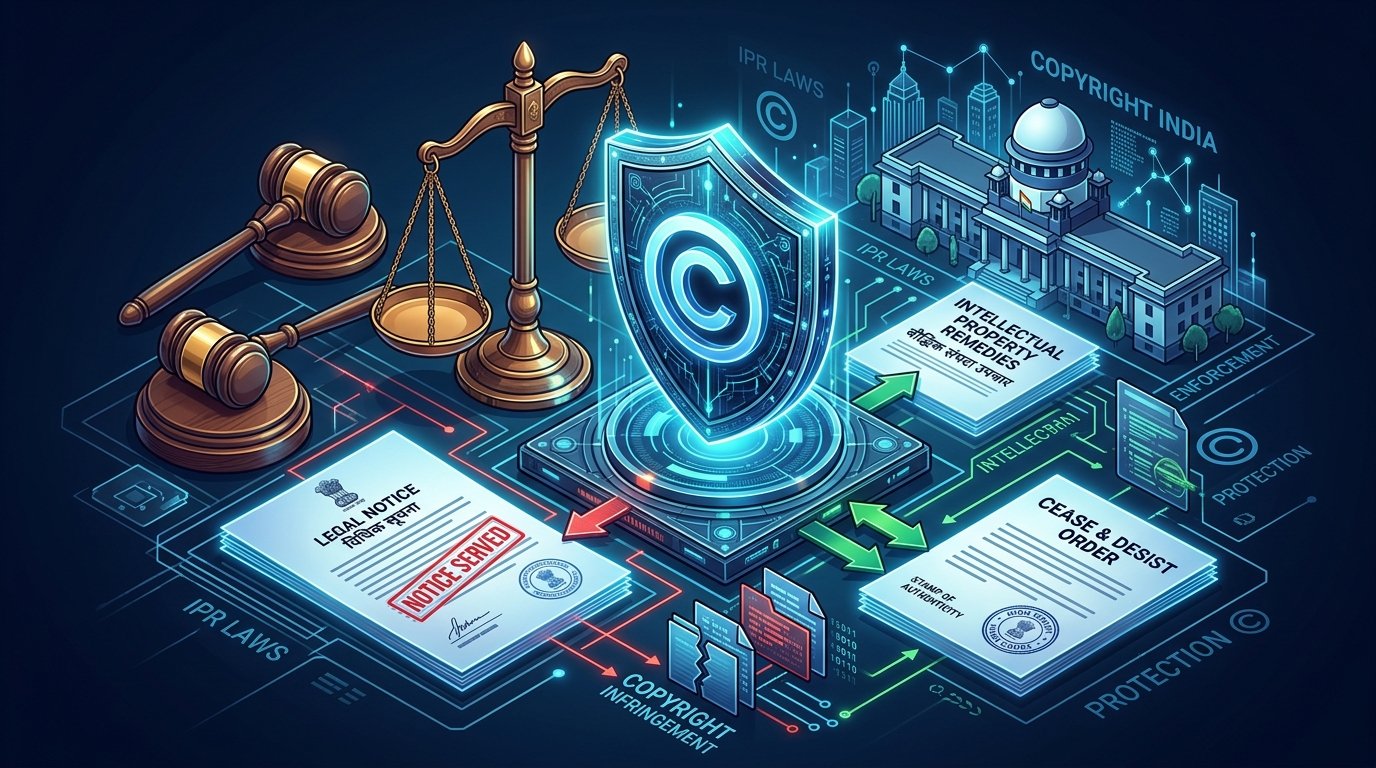
1. Statutory Grounds: What Qualifies as Copyright Infringement?
Under Section 51 of the Copyright Act, 1957, copyright is infringed when any party does anything the exclusive right to do which is conferred upon the owner by the Act, without obtaining an authorized license from the owner or Registrar of Copyrights.
Primary Infringement
Direct copying, reproducing, publicly broadcasting, transmitting, translating, or commercially exploiting the original protected work without authorization.
- Copying proprietary code into another application
- Uploading copyrighted videos to YouTube/social media
- Re-publishing digital books or educational modules
Secondary Infringement
Facilitating or trading in infringing copies with knowledge, including importing, distributing, exhibiting for sale, or providing premises/platforms for infringement.
- Hosting pirated content on web servers or cloud hubs
- Selling pirated software keys or installation media
- Distributing counterfeit digital design files
2. Step-by-Step Procedure: Issuing a Legal Notice
Before commencing expensive litigation in Commercial Courts, a formal Cease-and-Desist Notice drafted by an IP advocate serves as a critical first strike:
- Establish Title & Originality: Gather your Copyright Registration Certificate (Form XIV extracts) or dated git commits, source archives, and design files establishing prior creation.
- Preserve Digital Evidence: Document the infringement with timestamped screen captures, Wayback Machine archives, server logs, and transaction receipts before the infringer deletes them.
- Draft Specific Legal Demands:
- Immediate cessation of all unauthorized reproduction and distribution.
- Unconditional takedown of infringing URLs, listings, and social media posts within 72 hours.
- Written undertaking promising never to replicate the protected work.
- Rendition of accounts showing profits earned through the infringement.
- Reimbursement of statutory legal expenses and agreed damages.
- Serve via Registered Post & Electronic Mail: Dispatch through speed post with acknowledgment due (AD) and registered advocate email to establish formal legal receipt.
Need to register your copyright first? Learn about the complete registration flow in our Copyright Registration Guide (2026).
3. Civil Remedies vs Criminal Penalties: Comparative Matrix
Indian law empowers rights holders with robust civil and criminal enforcement mechanisms that can be invoked simultaneously:
| Category | Civil Remedies (Section 55) | Criminal Penalties (Section 63 & 64) |
|---|---|---|
| Forum | District Court or Commercial Court where the plaintiff resides (Section 62). | Metropolitan Magistrate or Judicial Magistrate of First Class / Cyber Crime Police. |
| Key Orders | Interim & Permanent Injunctions; Anton Piller Search Orders; Mareva asset freezes; John Doe (Ashok Kumar) unknown defendant orders. | Police seizure of infringing plates, servers, and duplicates without court warrant (Section 64). |
| Financial Outcome | Actual damages, punitive damages, and rendition of profits made by the infringer. | Fines between ₹50,000 to ₹2,00,000 payable to the state treasury. |
| Custodial Penalty | None (Civil contempt if court orders are breached). | Mandatory imprisonment of 6 months up to 3 years. |
4. Fair Dealing Defense under Section 52: When Use Is Legal
Under Section 52 of the Indian Copyright Act, not all unauthorized use amounts to infringement. India observes a statutory Fair Dealing doctrine (distinguished from the broader US "fair use" standard):
Private and Personal Use & Research
Reproduction of small portions for non-commercial academic study, scientific research, or private scholarship.
Criticism, Commentary & Review
Quoting excerpts for literary reviews or news critiques, provided adequate attribution and citation to the author is supplied.
Current Affairs & News Reporting
Broadcasting or printing summaries of public lectures or current events in print publications, television, or online journalism.
Judicial Proceedings & Legislative Reports
Reproduction of documents, contracts, and evidentiary material strictly for court filings, arbitration, and parliamentary proceedings.
Frequently Asked Questions on Copyright Infringement
Has Someone Stolen Your Original Content or Software?
CopyHart's IP litigators draft and serve immediate Cease & Desist legal notices, initiate DMCA & platform takedowns, and obtain Commercial Court injunctions across India.