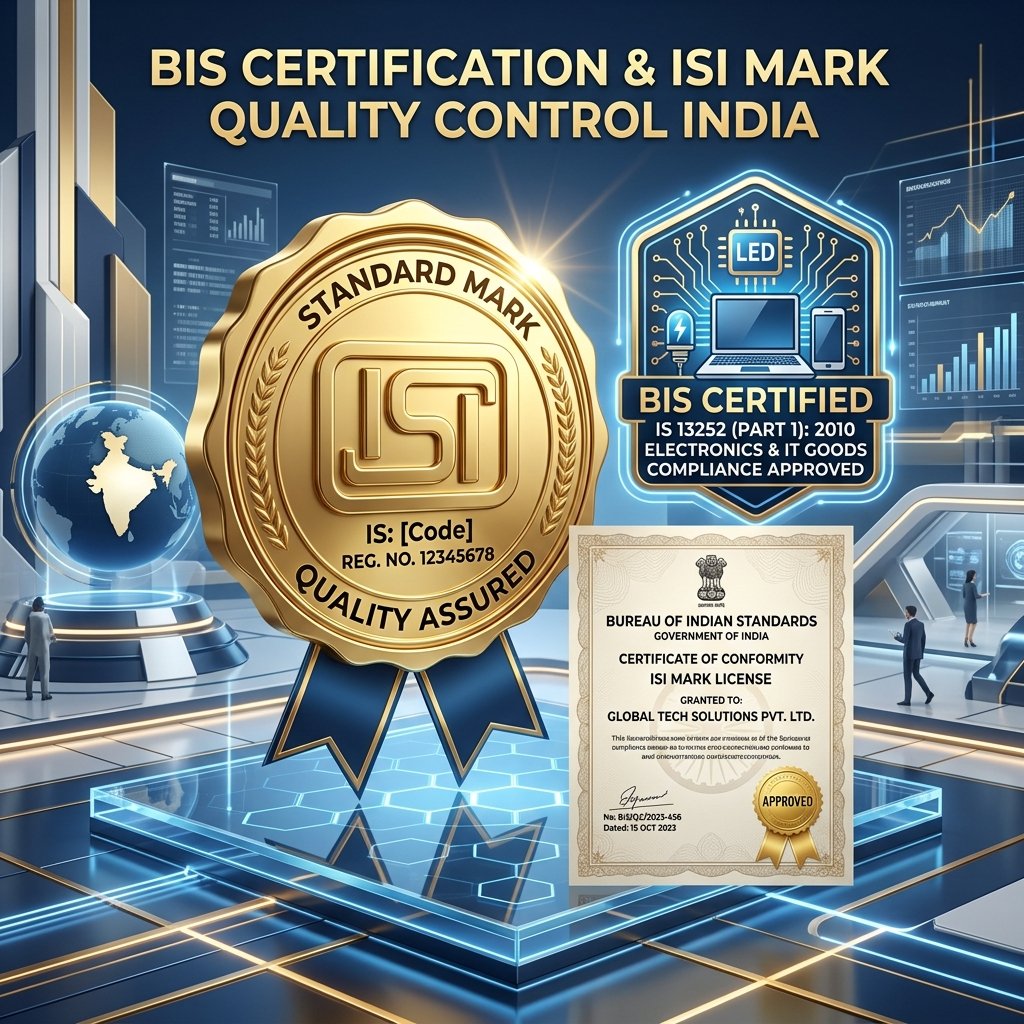
Introduction
India is one of the world’s fastest-growing manufacturing and consumer markets, making product quality and regulatory compliance increasingly important. To ensure public safety and standardization, the Government of India continuously enforces mandatory BIS certification for various product lines through Quality Control Orders (QCOs).
As these regulations expand across consumer and industrial sectors, domestic manufacturers, importers, and foreign brands must comply with BIS requirements before introducing products into the Indian market. This guide covers the essential aspects of BIS certification in 2026, breaking down schemes, mandatory product lists, 11 required documents, fee structures, and step-by-step registration workflows.
What is BIS Certification in India?
BIS Certification is an official conformity assessment issued by the Bureau of Indian Standards (BIS), the national standards body of India established under the BIS Act, 2016. It certifies that a manufactured or imported product complies with specified Indian Standards (IS) for quality, safety, and performance.
Products covered under mandatory regulations cannot be legally manufactured, imported, distributed, or sold in India without the required BIS approval. Depending on the product type, businesses must obtain specific certification schemes, such as ISI Mark Certification, BIS CRS Registration, FMCS for Foreign Manufacturers, or Scheme-X.
Why BIS Certification is Crucial in 2026
Products notified under Quality Control Orders (QCOs) strictly require mandatory BIS approval prior to market entry.
Verifies that products undergo lab testing and meet stringent Indian safety and performance benchmarks.
The recognized ISI mark or R-Number gives buyers confidence that products are safe, reliable, and authentic.
Non-compliance leads to customs import blockages, heavy financial penalties, product recalls, or prosecution.
Who Needs BIS Certification?
1. Indian Manufacturers
Domestic companies manufacturing items covered under mandatory QCOs must obtain factory inspection and lab testing certification.
2. Foreign Manufacturers (FMCS)
Overseas factories exporting regulated goods to India must obtain FMCS certification and appoint an Authorized Indian Representative (AIR).
3. Importers & Brand Owners
Importers and white-label brand owners selling under custom brand names must ensure products are backed by valid BIS registration.
4 Major Types of BIS Certification Schemes
1. ISI Mark Certification (Scheme-I)
Applies to electrical appliances, steel products, cement, cables, helmets, and household goods. Involves mandatory factory inspection and sample testing.
2. BIS CRS Registration (Compulsory Registration Scheme)
Primarily covers electronics and IT hardware. Requires product testing in BIS-recognized labs to obtain a unique R-Number.
3. FMCS – Foreign Manufacturers Certification Scheme
Enables overseas manufacturing units to obtain BIS licenses for exporting to India upon factory audit and AIR appointment.
4. Scheme-X Certification
Introduced under the Machinery and Electrical Equipment Safety (Omnibus Technical Regulation) Order 2024 by the Ministry of Heavy Industries for heavy industrial machinery.
BIS Certification Process: Step-by-Step Guide
Submit Application & Technical Specs
File application on BIS portal along with business registration, factory layouts, machinery lists, and technical product documentation.
Product Sample Testing
Submit product samples to a BIS-recognized NABL laboratory for testing against applicable Indian Standards (IS).
Factory Inspection & Quality Audit
For ISI and FMCS schemes, BIS auditors inspect factory quality control processes, testing equipment, and manufacturing flow.
Grant of License / R-Number
Upon successful test reports and audit verification, BIS issues the official License or CRS R-Number for product marking.
Renewal & Surveillance Compliance
Maintain ongoing quality standards and file periodic renewal applications to keep the certification active.
11 Essential Documents Required for BIS Certification
BIS Certification Fee Structure (2026 Estimates)
| Fee Component | Approximate Government Fee |
|---|---|
| Application Fee | ₹1,000 |
| Product Testing Fee | ₹10,000 – ₹1,50,000+ (Depends on IS standard & model count) |
| Factory Inspection Fee | ₹7,000 – ₹12,000 per man-day |
| Annual License Fee | ₹1,000 |
| Marking Fee | As applicable for specific product volume |
Estimated Overall Costs by Scheme:
- • ISI Mark Certification: ₹50,000 to ₹3,00,000+
- • BIS CRS Registration: ₹50,000 to ₹2,50,000+
- • FMCS Certification: ₹2,00,000 to ₹5,00,000+
Common Mistakes to Avoid During BIS Certification
Frequently Asked Questions (FAQs)
Conclusion
BIS certification is essential for ensuring product quality, consumer safety, and regulatory compliance in the Indian market. By understanding the certification process, choosing the correct IS standard, and avoiding common documentation errors, businesses can achieve faster approvals and seamless market entry.
Need Professional Assistance with BIS Certification?
Streamline your BIS registration process. CopyHart's compliance consultants assist manufacturers and importers with IS identification, lab test coordination, factory audit prep, and FMCS registration.